If you’ve read through this series, you’ve covered a lot of ground.
You’ve looked at what AI alignment actually means — and why it’s so hard to get right. You’ve thought about the Singularity and what it would mean to cross that threshold. You’ve sat with what’s happening to work, and with the framework Maslow offers for thinking about preparation at every level. You’ve looked at the conditions that make resilience matter, and you’ve tried to picture what a genuinely good future might look like.
So. What do you actually do with all of that?
I want to give you an honest answer — not a tidy one.
Where we actually are
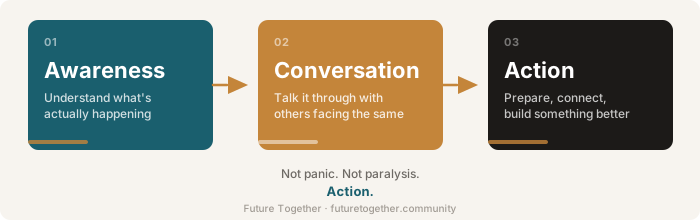
The first thing to say is this: we are still in the awareness and conversation stage. That’s not a limitation to apologise for. It’s an accurate description of where society is with this topic.
Most people — including most intelligent, engaged, thoughtful people — are not yet having serious conversations about AI development and what it means for how we live. The gap between what’s happening and what people understand is still enormous. Closing that gap is the most important work right now.
I don’t have a finished 10-step plan. I don’t think anyone does. What I have is a set of observations about where we are, and some honest thoughts about where to start. That’s what this article is.
What you can do
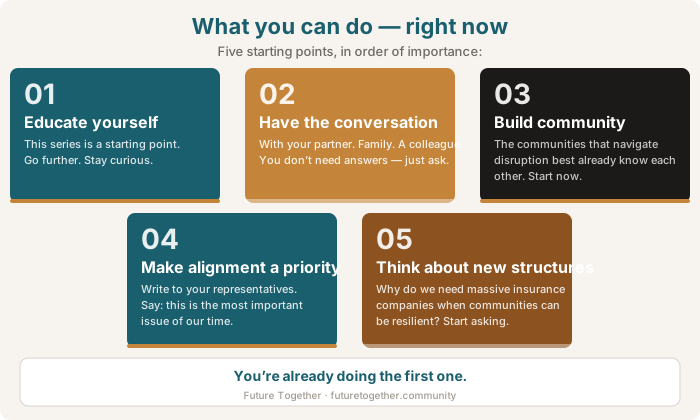
Educate yourself.
This series is a starting point, not a destination. The questions it raises have depth that nine articles can’t fully explore. Go further. Read Dario Amodei’s essay on what AI could make possible. Understand the alignment problem more deeply. Follow people who are working on these questions seriously — researchers, ethicists, policy thinkers. Stay curious without becoming a consumer of doom.
The goal isn’t to become an expert. It’s to be informed enough to have the conversation.
Have the conversation.
This is the most important thing you can do right now. Not a lecture — a conversation. With your partner. Your family. A friend who you think might be open to it. A colleague who’s been noticing changes in their work.
You don’t need to have answers. You need to be willing to ask the question: have you been paying attention to what’s happening with AI? What do you make of it?
The awareness has to spread through exactly that mechanism. One person saying to another: I’ve been thinking about this, and I think we should talk.
Build — or join — community.
Individual preparation has real limits. The communities that navigate disruption best are the ones with existing connections, distributed trust, and a shared sense of mutual obligation. Those things take time to build, which is why starting now matters.
This could look like deepening relationships in a community you’re already part of. It could look like joining Future Together’s online meetups and contributing your perspective. Or — and this is what I’d most love to see — it could look like starting something in your own town.
Make alignment a priority.
In whatever civic capacity is available to you — write to your local member of parliament or representative. Express that you believe AI alignment is the most important issue of our time. That everything else — economic policy, healthcare, housing, education — is secondary to ensuring the technology being built right now is oriented toward human flourishing.
This doesn’t require political expertise. It requires being willing to say, clearly and plainly: this matters, and I need you to take it seriously.
Think about new structures.
The existing systems — the way we organise work, distribute income, structure communities — were not designed for the world that’s coming. Start asking questions. Why do we need massive insurance companies when communities are resilient and self-sufficient? What would local governance look like if the assumptions underpinning it changed? What do we actually want to build?
These are long-term questions. But they need to start being asked now, so that when the moment comes to answer them, we’re not starting from scratch.
How I ended up here
I want to tell you something about why Future Together exists, because I think it’s relevant to the question of what you can do.
I didn’t start these meetups because I’m outgoing. I’m not, particularly. I didn’t start them because I had answers, or a plan, or a polished vision of what Future Together would become. I started them because I woke up one morning with an urgent, pressing sense that I needed to do something — and this was the something I chose.
More precisely: I woke up thinking about how I would feel if things in my community ended up going badly, and I had done nothing. That thought was intolerable. So I did something uncomfortable instead.
Running meetups — putting yourself in front of people, facilitating conversations about difficult and uncertain topics — is well outside my comfort zone. I mention that not to be self-deprecating, but because I think it’s informative. When something matters enough that you’ll do it despite the discomfort, despite not having all the answers, despite not being sure it will work — that’s a signal worth paying attention to.
I’m not the authority on what comes next. I’m someone who looked at what was happening and decided that having the conversation was better than staying silent.
If that resonates with you — if you’ve read through this series and feel some version of that same pull — then I’d encourage you not to wait until you feel ready. You won’t feel ready. Do it anyway.

Start something
Future Together is a model, not a monopoly. The most valuable thing that could happen is for more people, in more places, to start their own local conversations — their own meetups, their own groups, their own versions of this.
If you want to start a local Future Together group, we’ve put together some simple guidance to help you get started. You don’t need to be an expert. You don’t need a polished presentation. You need a room — or a video call — and a willingness to ask the question.
Start your own Future Together group →
What to carry forward
If I could leave you with three things from this series, they would be these.
Curiosity. The worst response to all of this is to switch off — to decide it’s too big, too uncertain, too far beyond your control to engage with. Stay curious. Keep learning. The picture will keep changing, and you want to be someone who’s watching it.
Education. Not passive consumption — active learning. Seek out the serious voices, the careful thinkers, the people who hold both the risks and the possibilities with equal honesty. Share what you learn. This is how the gap closes.
Hope. Not as a feeling you wait for, but as something you choose. The utopia outcome is genuinely possible. A world where AI handles the drudgery and humans get to be more fully human — more creative, more connected, more present — is a real destination worth working toward. It requires alignment to be achieved before we reach the threshold where it’s too late to steer. That’s why the conversations happening now, in meetups and kitchen tables and offices around the world, actually matter.
You’re already part of this. You read the series. You’re paying attention.
Now share it with someone who isn’t yet.
Future Together meets monthly — online, open to everyone. Come and be part of the conversation.