A few months ago, I mentioned Maslow’s Hierarchy of Needs in one of our monthly meetups. I wasn’t sure how it would land — it’s a 1940s psychology concept, not exactly cutting-edge — but the room shifted. People who’d never heard of it immediately saw the point. People who had heard of it saw it differently. Everyone found it useful.
That’s the thing about a good framework. You don’t need to be told what to do with it. It does the work itself.
What is Maslow’s Hierarchy?
The short version: Abraham Maslow proposed that human needs exist in a rough hierarchy, and that we tend to focus on lower-level needs before we can meaningfully address higher ones.

At the bottom: physiological needs — food, water, shelter, sleep. These are the baseline. Without them, nothing else really matters.
Above that: safety — security, stability, freedom from fear.
Then love and belonging — connection, community, relationships.
Then esteem — dignity, respect, a sense of purpose and contribution.
And at the top: self-actualisation — creativity, meaning, becoming the fullest version of yourself.
For a more complete explanation of each level, Wikipedia has a thorough overview. What I want to explore here is what this diagram becomes when you hold it up against the uncertainty ahead of us.
Two futures, one map
Here’s the honest framing I use when thinking about AI and what’s coming: I think the likely outcomes are more binary than most people assume.
Either we achieve the kind of AI alignment we need — systems that reliably do what’s actually good for humanity — and we move into a genuinely transformed world, one that could be extraordinary. Or we don’t, and we’re navigating something much harder.
I know that’s not a comfortable framing. And I acknowledge there is always potential for middle ground — a messy, ambiguous middle where things are neither catastrophic nor wonderful. But I think the nature of the technology makes clean middles unlikely. Alignment either works or it doesn’t. The systems are either oriented toward human flourishing or they’re not.
If you accept that framing — even tentatively — then the pyramid becomes useful in a very specific way.
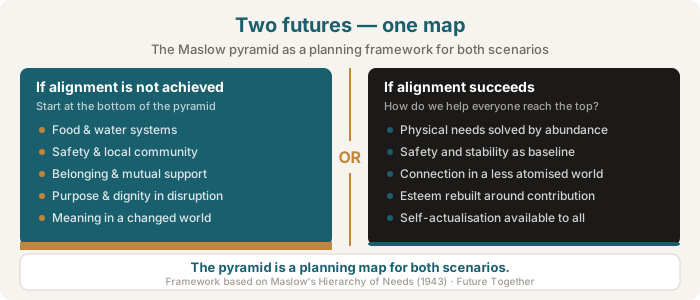
If things go badly, start at the bottom.
What do you actually need to sustain life? What does your household need, your street, your community? Food, water, shelter — the foundation of the pyramid — become practical questions rather than abstract ones. This isn’t about fear. It’s about being the kind of person who thinks ahead, who has a plan, who doesn’t get caught flat-footed.
If things go well, the question becomes: how do we help people move upward?
If AI does what its most optimistic proponents believe it can — eliminating scarcity, freeing people from drudgery, solving problems that have resisted human effort for centuries — then the challenge becomes something more interesting. How do you build a world where people can actually reach the top of the pyramid? Where self-actualisation isn’t a luxury for the few?
The pyramid, in other words, is a planning map for both scenarios.
The uncomfortable bottom
When I introduce this frame — “start with food, water, shelter if things go badly” — I notice something consistent. People want to skip past it.
It’s too confronting. It feels like survivalism, like prepper culture, like something that belongs to a different kind of person in a different kind of conversation. They ask: “But why would we ever be in that situation? What conditions would actually make food preparation necessary?”
That’s a fair question. And it deserves a proper answer — which is why there’s a whole separate article in this series dedicated to it: What conditions make food preparation important?. I won’t try to answer it fully here.
What I will say is this: in local meetups, once people get past the initial discomfort, the conversations become surprisingly practical. People talk about farms they have access to, about friends with land. About the resurgence of interest in canning and preserving food. About the kind of knowledge that used to be common and has slowly been outsourced to supermarket supply chains.
These conversations aren’t coming from fear. They’re coming from the same instinct that makes you renew your insurance, or keep a first aid kit in the car. Not because you expect disaster — because you’re the kind of person who thinks ahead.
The wide-open top
The other end of the pyramid raises a different kind of question. And in some ways it’s more unsettling — not because it’s dark, but because nobody has the answer.
If AI handles the drudgery — and there’s credible reason to think it could, eventually — what does daily life actually look like? What do people do?
For many people, work isn’t just income. It’s identity. It’s structure. It’s the answer to the question “what do you do?” and by extension “who are you?” Take the job away — even in a positive scenario where money is no longer the concern — and the question becomes genuinely open.
Does everyone take up painting? Gardening? Bush regeneration? Social gatherings? Creative projects they’ve deferred their entire lives?
In our meetups, this question generates the most curious energy — not anxiety, but genuine wondering. Nobody has an answer. The honest response is that we’ve never lived in a world where that question was real for most people, so we don’t have inherited frameworks for it. We’re going to have to figure it out.
What Maslow’s pyramid suggests is that this is actually the right question to be thinking about. If the lower levels are handled — if physiological needs, safety, and belonging are met — then self-actualisation becomes the work. Not a luxury. The work.
That’s a strange and hopeful thing to hold.
Community isn’t just one level
Here’s where the pyramid gets even more interesting, if you look at it through a Future Together lens.
Community shows up explicitly in the middle of the pyramid — love and belonging, the third level. But that undersells it. Community is relevant at every level. The interaction just looks different at each rung.
We are stronger when we grow food together than when we grow it alone.
We eat better — and something more than better — when we share meals rather than eat in isolation.
We are more engaged, more alive, when we sing and create alongside others rather than in private.
And we reach toward the top of the pyramid — toward meaning and self-actualisation — more powerfully in community than alone.
Humans are social creatures. That’s not a soft sentiment; it’s a design fact. Whatever level of the pyramid the future calls us to, we will navigate it better together than separately.
This is part of why community isn’t just something we build for the disruption ahead — it’s something we build toward. A destination as much as a preparation strategy.
Not answers. A map.
I want to be clear about what this framework is and isn’t.
It’s not a prescription. It’s not a list of things everyone must do. What the pyramid offers is structure — a way of organising your thinking about what matters and in what order.
Every family is different. Every community has different resources, different vulnerabilities, different values. A family with land and farming skills starts from a different place than a family in a high-rise apartment. A rural community with existing social networks is positioned differently than an atomised suburb.
What the pyramid asks is: where are you starting from, and what does moving up look like for you?
There are no universal answers. But there is a universal shape to the questions.
The Awareness → Conversation → Action arc that Future Together is built around applies here too. Start by understanding the framework. Have the conversations — with your household, your friends, your community — about where you are on the pyramid and where you want to be. Then take the steps that make sense for your actual situation.
You don’t need anyone to tell you what those steps are. You just need the map.
Want to think through this with others? We meet monthly — a discussion, not a presentation.