There’s a question I don’t ask often enough, and I’ve noticed others don’t either.
We talk about the risks. We talk about disruption, displacement, misalignment, preparation. We talk about what could go wrong and how to navigate it. All of that is necessary. But somewhere in that conversation, a different question tends to get lost:
What are we actually hoping for?
Not “what are we hoping to avoid?” — we have a lot of material on that. What are we hoping for? What does a genuinely good future look like, in concrete terms? What does your day actually look like if this goes well?
I think we need to be able to answer that question. Not just intellectually, but viscerally. Because fear is a motivator, but it’s not a destination. And the kind of action that Future Together is trying to encourage — the sustained, community-oriented, eyes-open engagement with what’s coming — requires more than fear to sustain it. It requires wanting something.
So let’s try to sketch it.
A personal picture
When I try to imagine AI going genuinely well — not just “crisis averted” but actually well — the picture I arrive at is surprisingly physical.
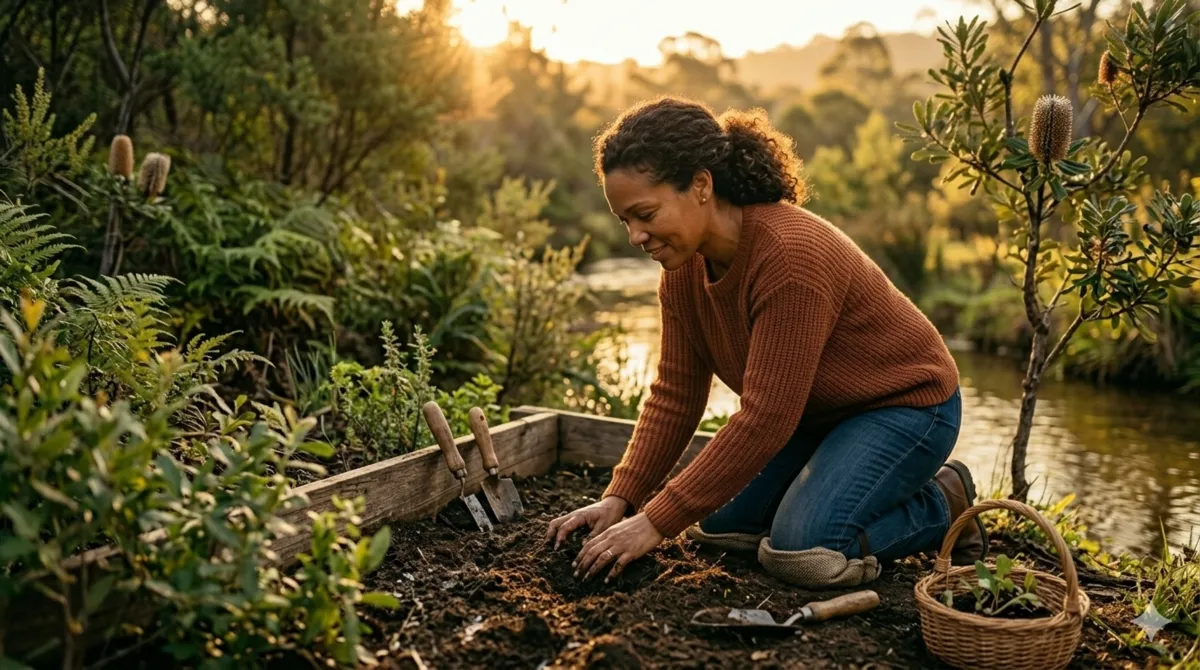
I’m outside. I’m in the garden, improving something, building something with my hands. I’m at the creek, joining in with a bush regeneration project. I’m helping someone build a house — not because I have to, but because it’s satisfying and they need the help. I’m at the local art gallery, talking with the artists, watching the people learning from them. I’m at the meditation centre — either in a yoga class or helping expand the building itself.
What’s notable about that picture, when I look at it honestly, is what’s not in it. There’s no screen. No client deadline. No context-switching between twelve open tabs. The things filling the day are physical, creative, relational, and chosen.
That’s not retirement. It’s not passivity. It’s a different orientation of effort — toward things that matter because they matter, not because they pay.
When I’ve asked this question in our meetups, people initially struggle with it. The first response is almost always practical: but what about money? The economic anxiety is real, and understandable — we’ve built our lives around the relationship between effort, income, and survival. Removing that equation, even in imagination, is genuinely disorienting.
But when people push past the practical, something interesting emerges. The common thread, when there is one, is creativity. Art. Making things. Contribution that doesn’t require a payslip to justify it.
Most people have a version of my garden in their imagination. They just haven’t been asked to describe it.
What Dario Amodei sees
Dario Amodei — one of the researchers at the forefront of AI development — wrote an essay called Machines of Loving Grace that is one of the more serious attempts to sketch the upside of this technology. It’s worth reading in full. Here are the parts that have stayed with me.
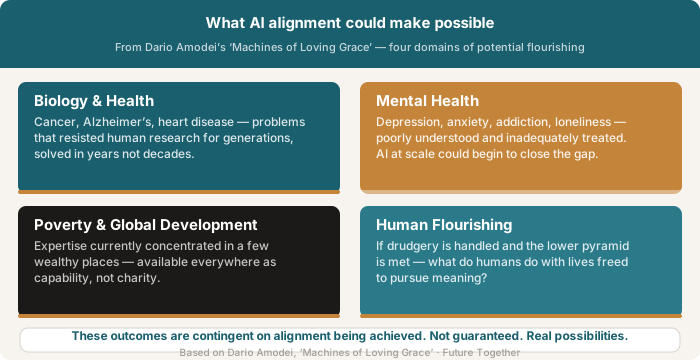
On biology and health: Amodei believes AI could compress decades of scientific progress into a few years — not by replacing scientists, but by dramatically accelerating the pace at which they can work. The target isn’t marginal improvements in treatment. It’s solving the problems that have resisted human research for generations: cancer in its many forms, Alzheimer’s and neurodegeneration, heart disease, mental illness, infectious disease. The potential isn’t adding a few years to the end of life in decline. It’s adding decades of genuinely healthy, capable living.
On mental health: This one is easy to overlook, but Amodei treats it as among the most important frontiers. Depression, anxiety, addiction, trauma, loneliness — these affect hundreds of millions of people and remain poorly understood and inadequately treated. The gap between what mental health care could be and what most people can access is enormous. AI, at scale, could begin to close it.
On poverty and global development: The expertise required to improve outcomes in medicine, agriculture, education, and governance is currently concentrated in a small number of wealthy places. AI could make that expertise genuinely available everywhere — not as charity, but as capability. Countries that have been held back by lack of access to knowledge could have it.
On flourishing: The less tangible dimension, and perhaps the most important. If the drudgery is handled — if the lower levels of Maslow’s pyramid are genuinely met — then the question becomes what human beings do with lives freed to pursue meaning. Amodei doesn’t pretend to know the answer. But he thinks the question itself is a remarkable thing to be in a position to ask.
These outcomes are not guaranteed. They’re contingent on AI going well — on alignment being achieved, on the technology being developed and deployed in ways that actually serve human flourishing rather than concentrating power. That’s the condition. But they’re real possibilities, and they’re worth holding in mind.
The structures we don’t have yet
At the societal level, I’ll be honest: I don’t know what the good future looks like in institutional terms.
My best guess is that many of the structures we currently have — the way work is organised, how income is distributed, how communities are governed — will not survive intact. Not necessarily through collapse, though that’s possible. More likely through a process of becoming increasingly mismatched with the reality they’re supposed to organise, and eventually giving way to something that fits better.
What replaces them, I genuinely don’t know. People raise universal basic income as one answer, and it’s a reasonable idea in the abstract — but I’m sceptical that the governments and institutions we currently have are capable of implementing it well, at the scale and speed that would be required. The machinery isn’t built for it.
My honest answer is that an aligned AI will help solve this in ways we can’t currently comprehend. That’s not a comfortable answer, and I recognise it could sound like a dodge. But I think it’s actually the most truthful position available. We are trying to anticipate the implications of a technology that, if it works as its most serious proponents believe it might, will be qualitatively more capable than anything we’ve built before. Expecting ourselves to fully pre-design the social arrangements of a world shaped by that technology is probably not realistic.
What we can do is be part of the conversation — about values, about what we want, about what kind of future we’re trying to build. The answers will need to be worked out. The question is whether we’re paying attention and engaged when they are.
Why this matters
There’s a reason this article exists in a series that’s otherwise heavily focused on risks, disruption, and preparation.
Fear is real information. The risks covered in this series — to work, to supply chains, to social stability, to alignment itself — are worth taking seriously. But fear alone is not a good guide for action. Fear contracts. It makes people defensive, reactive, and focused on the short term. It’s not the right state from which to think clearly about what kind of future we want to help build.
What I want you to take from this article is simple: the utopia outcome is genuinely desirable. Not as a fantasy — as a real possibility that is worth working toward.
That matters because the path to that outcome runs through alignment being achieved before we reach the threshold at which AI becomes self-directing and beyond our influence. The window for getting that right is not infinite. The decisions being made right now — in research labs, in boardrooms, in governments — will shape which direction this goes.
The most important thing ordinary people can do is be part of the conversation. Not because you have the technical answers — but because the people who are making these decisions are operating in a world where most of the public isn’t paying attention. Your attention matters. Your voice matters. The pressure of an informed, engaged public matters.
That’s why awareness and conversation come before action in the Future Together model. You have to be able to picture what you’re working toward. You have to want it.
Do you?
What does a good future look like to you? Bring the answer to our next meetup.